Let us start with an interesting paradox.
We live in an era where businesses have access to more data than ever before. Yet, turning that data into meaningful, actionable insights remains a challenge. What if the problem isn’t the lack of data or tools, but the way organizations interact with their information?
The days when data analysis required advanced technical skills and complex query languages are fading. Today, Large Language Models (LLMs) are transforming how people access and understand data by enabling natural language interactions with complex datasets. Executives can simply ask questions like “How did our Q3 sales compare to last year?” or “Which customer segments grew the fastest last month?” and receive clear, actionable answers in seconds.
This shift is reshaping decision-making across industries. From healthcare professionals analyzing patient outcomes to retail managers optimizing inventory, LLM-powered analytics puts powerful insights directly into the hands of those who need them, exactly when they need them.
Key Takeaways
How Large Language Models Enhance Data Analytics
Traditional data analytics excels at processing numbers and identifying patterns in large datasets. LLMs bring a complementary capability: understanding language, context, and nuance.
On their own, LLMs were not designed to analyze raw business data at scale. However, when combined with established analytics tools, something powerful happens. Together, they allow decision-makers to have real conversations with their data. Users can ask follow-up questions, explore “what-if” scenarios, and investigate anomalies in real time, at the exact moment decisions need to be made.
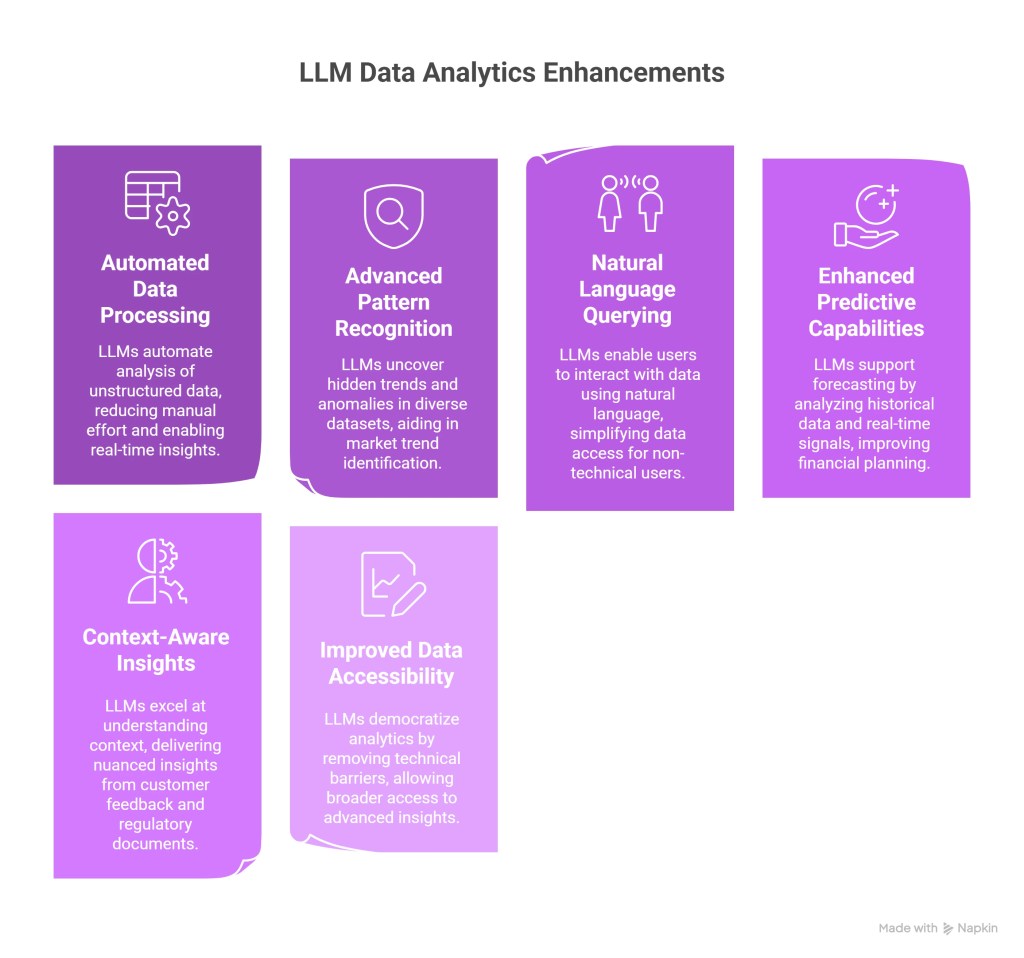
Automated Data Processing
LLMs can process and analyze vast amounts of unstructured data, including emails, reports, social media posts, and customer interactions. This automation reduces manual effort and enables real-time insight generation, allowing organizations to respond quickly to changing conditions.
Advanced Pattern Recognition
By analyzing large and diverse datasets, LLMs can uncover hidden trends, correlations, and anomalies that traditional tools may overlook. This helps organizations identify emerging market trends, understand customer behavior, and detect operational risks early.
Natural Language Querying
Unlike traditional analytics tools that rely on complex query languages, LLMs enable users to interact with data using natural language. Business users can ask questions such as “What factors are driving customer churn?” and receive data-backed answers without technical expertise.
Enhanced Predictive Capabilities
LLMs support forecasting by analyzing historical data, industry reports, and real-time signals. This allows companies to anticipate market shifts, optimize inventory, and improve financial planning through more informed predictions.
Context-Aware Insights
While traditional analytics often struggles with context, LLMs excel at it. Whether analyzing sentiment in customer feedback or interpreting regulatory documents, LLMs deliver insights that reflect nuance and intent, not just numbers.
Improved Data Accessibility
By removing technical barriers, LLMs democratize analytics. Executives, marketers, and operations teams can all access advanced insights without relying exclusively on data science teams.
Advantages of Implementing LLM-Based Analytics
While the capabilities of LLM-powered analytics are impressive on their own, their true value becomes clear when translated into tangible business outcomes. Organizations adopting LLM-based analytics are not just improving how data is analyzed; they are fundamentally enhancing how decisions are made across the business.
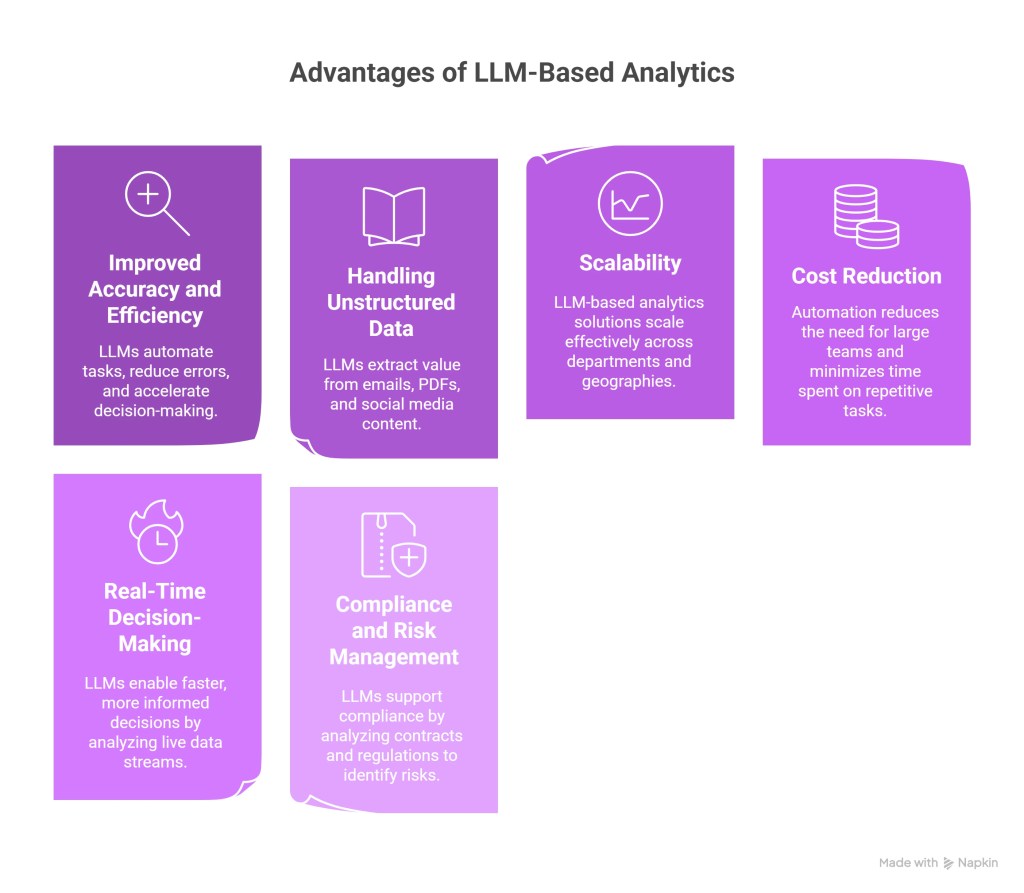
Improved Accuracy and Efficiency
LLMs reduce human error by automating complex analytical tasks and interpreting unstructured data with high precision. This accelerates decision-making and allows teams to focus on strategic initiatives instead of manual data processing.
Handling Unstructured Data
Unstructured data accounts for an estimated 80–90% of enterprise information. Unlike traditional tools, LLMs can extract value from emails, PDFs, legal documents, chat logs, social media content, and more—making them especially valuable in sectors like healthcare, legal services, and customer support.
Scalability
LLM-based analytics solutions scale effectively across departments and geographies. Whether analyzing millions of customer interactions or global financial reports, these systems adapt to growing data volumes without proportional increases in operational complexity.
Cost Reduction
Automation reduces the need for large, specialized analytics teams and minimizes time spent on repetitive tasks. In industries such as manufacturing, LLMs also enable predictive maintenance, helping prevent costly downtime by identifying risks before failures occur.
Real-Time Decision-Making
By analyzing live data streams, LLMs enable faster, more informed decisions. In finance, they help interpret news and market signals in real time. In e-commerce, they dynamically adjust recommendations based on customer behavior to improve conversion rates.
Compliance and Risk Management
In highly regulated industries, LLMs support compliance by analyzing contracts, regulations, and reports to identify risks and anomalies. They assist with audits and help organizations adapt to evolving regulatory requirements with less manual effort.
Real-World Use Cases of LLM-Based Analytics
While LLM-based analytics is often discussed in theoretical terms, its real value emerges in everyday business operations. Across industries, organizations are already using Large Language Models combined with analytics platforms to solve concrete problems, reducing costs, improving efficiency, and enabling faster, more informed decisions.
What makes these use cases particularly powerful is not just automation, but the ability to connect structured data with unstructured information and interpret it in business context. Below are examples of how LLM-based analytics is being applied in real-world scenarios across key industries.
Automotive Industry
In the automotive sector, manufacturers operate within highly complex ecosystems involving production plants, suppliers, logistics providers, and dealerships. LLM-based analytics is increasingly used to bring clarity to this complexity.
By analyzing sensor data from vehicles and manufacturing equipment alongside maintenance reports and historical failure records, LLM-powered systems help predict component failures before they occur. This enables predictive maintenance strategies that reduce unplanned downtime, lower warranty costs, and improve vehicle reliability.
Beyond production, automotive companies use LLMs to optimize global supply chains. By combining structured data (inventory levels, delivery schedules) with unstructured inputs (supplier emails, shipment updates, market news), LLM-based analytics provides early warnings about potential disruptions. Decision-makers can ask natural language questions such as “Which suppliers are most at risk of delays next quarter?” and receive context-aware insights that support proactive planning.
Finance
In finance, speed, accuracy, and context are critical. LLM-based analytics supports financial institutions and corporate finance teams by synthesizing vast amounts of structured and unstructured data into actionable insights.
Investment and risk management teams use LLMs to analyze historical market data alongside earnings reports, analyst commentary, regulatory filings, and real-time news. Instead of manually reviewing dozens of sources, analysts can ask questions like “What macroeconomic factors are currently impacting our portfolio risk?” and receive summarized, data-backed answers.
In corporate finance, LLM-based analytics improves forecasting and planning by identifying patterns across financial statements, operational metrics, and external market signals. This allows finance teams to detect early signs of revenue volatility, cost overruns, or liquidity risks, and adjust strategies before issues escalate.
Healthcare
Healthcare organizations deal with massive volumes of sensitive, highly unstructured data. LLM-based analytics plays a growing role in transforming this information into clinical and operational insights.
By analyzing patient records, clinical notes, lab results, and medical literature, LLM-powered systems can support clinicians in diagnosis and treatment planning. These tools help identify correlations across patient histories, flag potential risk factors, and surface relevant research tailored to a specific case.
On an operational level, healthcare providers use LLM-based analytics to improve resource allocation and patient flow. For example, by analyzing admission data, staffing schedules, and historical demand patterns, hospitals can better anticipate peak periods and reduce bottlenecks, improving both patient outcomes and operational efficiency.
Marketing and Customer Experience
In marketing, understanding customer intent and sentiment is often more valuable than analyzing raw metrics alone. LLM-based analytics enables companies to capture this deeper layer of insight.
By processing customer feedback, social media conversations, support tickets, and survey responses, LLMs help organizations understand why customers behave the way they do, not just what they do. Marketing teams can ask questions like “What are the main reasons customers are dissatisfied with our latest product release?” and receive structured summaries grounded in real customer language.
These insights enable more personalized marketing campaigns, improved customer segmentation, and faster responses to emerging issues. Over time, organizations can use this knowledge to refine product offerings, improve messaging, and strengthen customer loyalty.
Operations and Enterprise Decision-Making
Beyond specific industries, LLM-based analytics is increasingly used at the enterprise level to support cross-functional decision-making. Executives and operational leaders use natural language interfaces to explore performance metrics, identify anomalies, and test scenarios without relying on technical intermediaries.
For example, operations teams can combine sales data, logistics information, and customer demand signals to ask “What operational bottlenecks are most likely to impact revenue this quarter?” The system not only analyzes the data, but explains the reasoning behind its conclusions, making insights easier to trust and act upon.
Challenges and Future Considerations About LLM-Based Data Analytics
Despite their benefits, LLM-based analytics solutions present challenges. Privacy and security concerns are critical when handling sensitive data. Bias and ethical risks require ongoing monitoring to prevent amplification of existing prejudices. Additionally, these systems demand significant computational resources and specialized expertise. Organizations that address these challenges proactively can unlock the full potential of LLM-driven analytics.
As LLMs continue to evolve, their role in analytics will expand. Integrations with machine learning, generative AI, and traditional BI tools will further enhance decision-making capabilities. LLMs are set to become a core component of business intelligence, delivering faster, more adaptive, and context-aware insights.
Conclusion
The combination of Large Language Models and data analytics is transforming how organizations make decisions. By allowing people to interact with data using natural language, LLM-powered analytics makes insights accessible far beyond technical teams.
While challenges such as privacy, bias, and resource requirements remain, the value of real-time, actionable insights from both structured and unstructured data is undeniable. Ultimately, the true power of this shift lies not only in the technology itself, but in how it reshapes organizational culture, making data-driven decision-making a shared capability across the business.
FAQ: Large Language Models in Data Analytics
How do LLM-based analytics change the role of traditional BI dashboards?
LLM-based analytics do not replace dashboards but shift them from being the primary interface to a supporting layer. Dashboards remain useful for monitoring known KPIs, while LLMs enable exploratory analysis—answering ad hoc questions, explaining anomalies, and connecting insights across systems that dashboards were never designed to integrate.
What skills do organizations need to successfully adopt LLM-powered analytics?
Rather than deep data science expertise across the business, organizations need strong data governance, clear semantic models, and domain experts who can frame meaningful questions. The emphasis moves from technical query writing to data stewardship, critical thinking, and decision literacy.
How can trust be established in insights generated by LLMs?
Trust is built through transparency and traceability. Effective systems link answers back to underlying data sources, assumptions, and reasoning steps. When users can see why an insight was produced, and validate it against known data, they are more likely to rely on it for decisions.
Are LLM-based analytics suitable for small and mid-sized organizations?
Yes, especially because they reduce dependence on large analytics teams. Smaller organizations can leverage cloud-based LLM solutions layered on existing data tools to gain advanced analytical capabilities without building complex infrastructures from scratch.
How might LLM-based analytics influence organizational culture over time?
Over time, these tools encourage a more inquisitive and collaborative culture. When employees at all levels can ask questions and explore data freely, decision-making becomes more distributed, assumptions are challenged more often, and data-driven thinking becomes a shared responsibility rather than a specialized function.
This post was originally published on March 6, 2025. It was most recently updated and expanded on December 19, 2025 to incorporate new information and best practices.