Before 2020, “LLM” was a niche term confined to tech circles and researchers in AI and machine learning, but everything changed when OpenAI introduced ChatGPT, a natural language processor (NLP) based on GPT-3.0 architecture. Moreover, the model is open source, which means full availability for anyone to use.
However, not long after, its subsequent versions appeared, such as GPT-3.5 and GPT-4. These models for differ have limited access, which made them commercial or proprietary LLMs. This has intensified the debate on whether LLMs should be publicly available or limited for specialized use cases.
Key Takeaways
What is a Large Language Model (LLM)?
Nowadays, AI capabilities are spreading rapidly, and it is causing tons of new technologies to happen. Some AI applications are already commonly known, and so are so-called large language models (LLMs). But how much do we actually know about how they work?
As a form of artificial intelligence, these models offer a natural language understanding and generate text responses suitable for your specific needs. However, what made them an especially well-liked choice for business operations is their ability to comprehend natural language, allowing them to interact with humans like conversational partners. Some of the most popular llms include:
- GPT-3.5 and GPT-4;
- Claude;
- BERT.
These models are trained on vast amounts of data and use deep learning techniques, allowing them to accurately predict the next words or word sequences in a given context. LLMs offer to:
- Give answers to questions
- Translate text
- Summarize blocks of text
- Understand the intent of a piece of content
- Classify and categorize content
- Rewrite content in a different tone, style, etc.
- As chatbots and virtual assistants
However, to ensure the model remains suitable for various business needs, there are LLM models specially designed for different tasks. Due to the capabilities, regulations about data privacy, and the methods of deployment, we can differentiate between two types of LMS: open-source and closed-source (also known as commercial LLMs).
What are Open-Source LLMs?
To better understand how to choose an LLM for various projects, let’s compare commercial and open-source options. As they do not differ much in ease of use, the main gap is the budget.
Open-source LLMs are built on a foundational architecture, and the source code is readily available to the public. They are free-for-all LLMs with no restrictions on use, alteration, or distribution.
Public availability means developers, researchers, organizations, and commercial entities can legally modify and distribute it at their discretion. It also promotes transparency and spurs innovation since it allows individuals, organizations, and enterprises to create adaptations of the models to suit their needs.
Common Features of an Open-Source LLM
It might be said that the free solutions often offer us limited capabilities. However, open-source LLMs provide us a great scope of useful features.
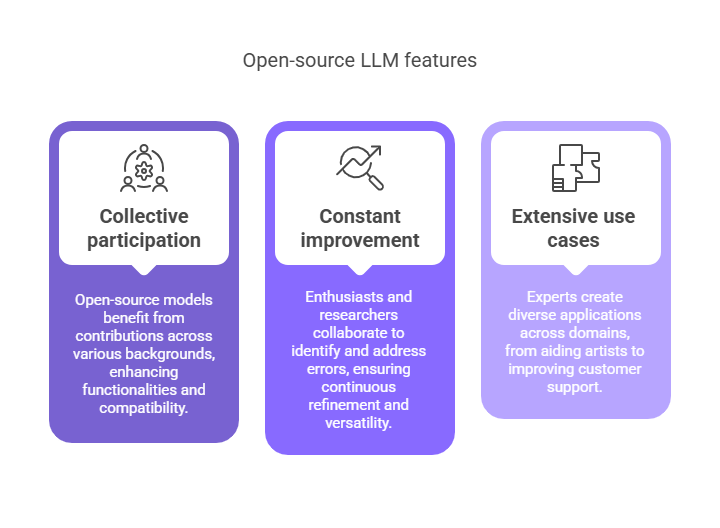
Collective participation and contributions
Open-source models offer contributions from across the divide. Anyone from students, hobbyists, and researchers to tech developers can give their input and contribute to the model’s enhancements. This fosters a collaborative environment to help expand the model’s functionalities, applications, and compatibility across various devices.
Constant improvement and rapid evolution
A community of hobbyists, enthusiasts, and researchers works tirelessly to ensure the iterative improvement and rapid evolution of open models. The internet is rife with forums, Wikis, and social media groups where users collaborate to identify errors, bugs, and shortcomings with current models and address them accordingly. This constant feedback loop enables continuous refinement and improved versatility.
Extensive use cases
Industry experts from all sectors can chip in and help create various use cases for open models across different domains. Poets and artists, for instance, can develop open-source LLMs to aid their creative process by exploring artistic styles and forms and generating inspirational prompts. Corporate entities can also provide data on market trends and consumer behavior to improve the applications of LLMs on customer support chatbots for better customer satisfaction.
What are Commercial LLMs?
Unlike open-source models, commercial solutions restrict access to their source code and architectural framework. Closed-source llms are proprietary, and the owners control access, which means other entities can access the source code on condition that they adhere to the owner’s terms and conditions. There are four main types of commercial models, namely:
- Proprietary models: These are closed-source LLMs that enterprises and organizations are developing for specific use cases within their ecosystems. A great example is Apple’s voice assistant, Siri, which only works with Apple devices.
- Customized solutions: Customized solutions are similar to proprietary models but on a narrower scale. These are models developed to accomplish specialized tasks for businesses or clients. For instance, a tech company may create a customized solution for a particular client. This model will recommend ways to streamline its supply chain based on customer demand, market trends, and data analytics.
- Enterprise models: Large corporate entities and tech giants like Google and Microsoft create enterprise models to accomplish specific business-related objectives. They then offer these models to businesses at a fee but restrict access to the source code. Common examples of enterprise large language models include Google Cloud AI, Microsoft Azure AI, and Amazon Web Services (AWS) AI.
- Subscription-based services: As the name implies, subscription-based services are models where users pay a subscription fee to access the model’s features. The best example of a closed subscription-based service is the latest GPT version, GPT-4o, which is only available to users at a fee. Again, access to the foundational framework is restricted, but users can utilize the model’s capabilities via an API or dedicated platform.
Common Features of a Commercial LLM
Commercial large language models take a more protectionist approach to development, focusing on consistent performance, security, and standardization. Below are their most notable features:
Exclusive use and copyright protection
The source codes of commercial models are copyright-protected under legally recognized licenses. This means that they remain the owners’ intellectual property, who have full control over their production, distribution, and modification. Companies use these models to gain a competitive advantage over others.
Standardization and quality control
Commercial models have dedicated teams of AI and IT experts to ensure consistent quality and standardized use. These teams check the models’ performance metrics, industry compliance, and satisfaction levels. They also troubleshoot for bugs, errors, and other issues without outsourcing to external service providers.
Customization and unique applications
Closed-source LLMs allow a limited degree of customization to meet specific user needs. However, only the owner can make these modifications, usually at a fee. They also allow seamless integration with existing systems since the models are designed to work with specific operational infrastructures and technologies.

Open Source VS Commercial LLMs: How to choose the right one for the enterprise
As you see, using open-source models for certain tasks would be a perfect option, while solutions from commercial providers may be a must for the others. That’s why the choice is not obvious in many cases.
Here are a couple of situations when you should choose to use an open-source model:
- You have a limited budget: One of the greatest advantages of open-source large language models is public availability. That means you don’t have to pay a dime to access or use them. This makes them ideal for individuals and businesses on a tight budget.
- You want flexibility and customization: Open models give unlimited access to the source code. As such, you can customize the llm to meet your needs without fearing legal consequences. This makes open models the better option for those who want to adapt the model to their needs or innovate using a collaborative approach (team projects and community initiatives).
- You want to learn and experiment: Unrestricted access to the foundational architecture means you can experiment with open models. They’re great for learning and allow limitless experimentation.
- You want diverse use cases: A growing community of developers, hobbyists, and AI enthusiasts means open-source models can have diverse applications. For instance, you can use LLAMA 2 to power chatbots in your online store and Vicuna 13-B to tutor your students during remedial classes.
That said, open-source models have certain limitations that may preclude their use for certain applications or in specific environments. You’ll be better off using commercial models if:
- You want security and privacy: Proprietary models are more secure than open ones since they limit access to a select group of people. In-house experts also update them regularly to address security vulnerabilities, making them ideal for individuals or businesses handling sensitive data.
- You have available resources: Commercial LLMs are the better option if you have the funds and resources to invest in a robust solution. This will give you an edge over competitors relying on open-source LLMs who may face limitations.
- You need a reliable model with dedicated support: Some businesses and individuals can’t afford downtime occasioned by undue errors in their systems. Closed-source LLMs are less likely to experience such crippling errors. If they do, they’ll have a dedicated support team to address them as soon as they occur.
- You must observe regulatory compliance: Certain industries have strict regulations and policies, necessitating commercial LLMs. These models have the infrastructure and human resources to ensure full compliance with these regulations.
| Open-Source | Commercial LLM |
|---|---|
| Limited budget | Security and privacy |
| Flexibility and customization | Available resources |
| Learn and experiment | Dedicated support |
| Diverse use cases | Regulatory compliance |
Final Thoughts
The choice between open-source and closed-source llms ultimately depends on your needs, resources, and priorities. Open-source llms are flexible, transparent, and allow community collaboration. They’re excellent for general use and day-to-day applications. However, if you want more specialization and control over your activities, you’re better off with closed llms. The major caveat is that they come at a considerable cost and may not be as customizable as open models.
Of course, you can always adopt a hybrid approach, using open-source models for experimenting and flexible applications and closed ones for critical, time-sensitive operations. Regardless of your choice, ensure you select a model that can effectively address your needs and seamlessly integrate with your systems and current workflows.
FAQ: Understanding and Choosing Large Language Models (LLMs)
How do LLMs impact long-term business strategy beyond immediate automation gains?
LLMs can reshape business strategy by enabling data-driven decision-making, accelerating product innovation, and creating new revenue streams (such as AI-powered services). Over time, organizations that integrate LLMs effectively can gain competitive advantages through faster insight generation and improved customer experiences, rather than just short-term efficiency gains.
What hidden costs should organizations consider when adopting open-source LLMs?
While open-source LLMs are free to use, they often require significant investment in infrastructure, skilled personnel, model maintenance, security hardening, and compliance management. These operational and staffing costs can sometimes rival or exceed the subscription fees of commercial LLMs.
How do data governance and ownership differ when using commercial LLM APIs versus self-hosted models?
With self-hosted (often open-source) LLMs, organizations retain full control over their data and how it is stored, processed, and audited. In contrast, commercial LLM APIs may process data externally, which can introduce concerns around data residency, retention policies, and third-party access, requiring careful contract and compliance review.
Can smaller organizations realistically compete with enterprises using advanced commercial LLMs?
Yes, smaller organizations can remain competitive by leveraging open-source LLMs, focusing on niche domains, and fine-tuning models with high-quality, domain-specific data. Strategic specialization and agility can often offset the raw scale and polish of enterprise-grade commercial models.
How might regulation influence the future balance between open-source and commercial LLMs?
Stricter AI regulations may favor commercial LLMs in highly regulated industries due to their compliance guarantees and managed governance. At the same time, regulation could also strengthen open-source ecosystems by encouraging transparency, auditability, and standardized safety practices, potentially leading to more regulated but still open innovation.
This post was originally published on June 26, 2024. It was most recently updated and expanded on December 19, 2025 to incorporate new information and best practices.